It may sound unbelievable, but Iran has reportedly managed to import around $2 billion worth of military equipment despite US naval restrictions and Western sanctions. According to an investigative report by Reuters, Tehran has built an extensive covert network involving more than 5,000 entities to procure military equipment, explosives and heavy vehicles while evading international restrictions.
The Reuters investigation found that Iran imported at least $2 billion worth of military-related equipment through this network between January 2025 and the period covered by the investigation.
Despite using thousands of missiles and drones during the conflict that began with US and Israeli strikes on February 28, Iran has continued replenishing its weapons stockpiles. The investigation provides insight into how the country’s military supply system operates.
According to Reuters, the network involves Iran’s Islamic Revolutionary Guard Corps (IRGC) and business groups known as Bonyads, which are controlled by influential elites. Financial transactions linked to the network can reportedly be traced through shipping documents and cargo clearance records dating back to 2016.
The entities operate under numerical identities rather than conventional company names, making them difficult to identify and sanction. Reuters said it found no independent evidence that Western governments had successfully imposed sanctions on these specific entities.
How the Covert Network Operates
According to the investigation, the secret network has become a central component of Iran’s military procurement system and its efforts to circumvent sanctions. Reuters and US-Israeli risk analysis firm 240 Analytics said their investigation uncovered the existence and structure of this network for the first time.
The entities generally have names beginning with the English abbreviation ‘MOD’ or the Persian abbreviation ‘VODJA’, followed by a five- or six-digit number written out in words.
All these entities reportedly use the address of Iran’s Ministry of Defence in Tehran as their registered location. Their official establishment date is listed as February 11, 1979, the day Ayatollah Ruhollah Khomeini came to power.
However, corporate records indicate that most of these entities were actually established in 2013, when Western sanctions had severely affected Iran’s oil exports and foreign exchange market.
According to Reuters, the entities conduct transactions through a complex web of intermediaries and foreign shell companies. Collectively described as ‘trustees’, these intermediaries help channel revenue from illicit oil sales into the procurement of missile and drone components.
The financial arrangements are particularly sophisticated. Approximately 97 per cent of the transactions associated with the imported goods were reportedly settled without conventional currency transfers.
Reuters examined several shipments containing information suggesting that very little money moved directly across international borders. This arrangement helped reduce the likelihood of transactions being detected by sanctions-monitoring authorities.
Among the imported goods were chemicals used in rocket fuel production, machinery components and heavy missile-launching vehicles. The reported countries of origin included China, Russia and Germany.
How the Network Was Discovered
Noam Binstock, an economist at 240 Analytics, first identified the pattern of the network in June 2025.
He discovered it while analysing leaked documents from Bank Sepah, which handles salaries and payments for members of Iran’s Islamic Revolutionary Guard Corps. The documents had circulated on Telegram and the WikiIran website.
The records showed that, by late 2024, 36 of these entities held approximately $1.2 billion in foreign currency. Other entities reportedly held around $1.8 billion in local currency.
Further investigation revealed that the entities were receiving oil revenue and purchasing dual-use equipment.
Each entity had a separate 11-digit identification number, which also appeared in shipping documents, invoices and bank records. These identifiers helped investigators trace the network despite the use of shell companies.
Reuters cross-referenced a sample of approximately 19,000 import records with shipping documents, social media videos, satellite imagery and information published by Iranian state media.
MOD 346428: The Network’s Largest Importer
The largest entity identified in Iran’s covert procurement network is MOD 346428.
Its imports totalled $442 million in the year ending March 2023. The figure subsequently increased to $988 million in the following year, placing the entity among Iran’s top 10 importers.
Between January 2025 and June 2026, MOD 346428 imported military-related equipment worth approximately $2.3 billion, according to Reuters. The shipments reportedly included rocket-fuel ingredients, explosives and various weapons components.
Between January and April 2025, the entity imported 886 tonnes of chemicals from China. These included sodium chlorate and various perchlorates, which are important raw materials for producing solid-fuel rockets.
The chemicals were transported through the Iranian port of Bandar Abbas.
According to sources cited by Reuters, sodium perchlorate from one of these shipments may have contributed to the massive explosion at Shahid Rajaee Port in southern Iran on April 26, 2025.
The explosion reportedly occurred after chemicals stored inside a shipping container caught fire.
Iranian state media identified Sina Port and Marine Services Development Company as the organisation responsible for storing the chemicals. The company is controlled by the Bonyad Mostazafan, a foundation with assets worth several billion dollars and direct ties to Iran’s Supreme Leader.
At least 70 people were killed and more than 1,200 others were injured in the explosion.
Imports of Trucks and Missile Launching Vehicles
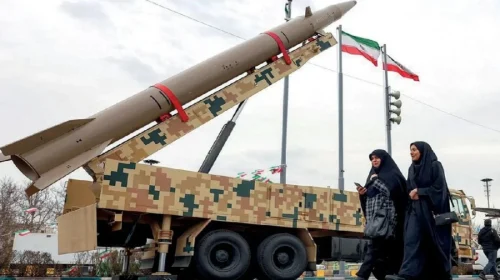
MOD 346428 also imported 435 Iveco trucks, which Iran’s military can reportedly use as disguised mobile missile-launching platforms.
In 2022, six similar trucks were purchased, eventually reaching Sahara Thunder, an Iranian drone manufacturer. The United States sanctioned the company in 2024 over allegations of involvement in trade with Russia.
The entity also imported thousands of Toyota Hilux and Land Cruiser pickup trucks. The IRGC reportedly modifies these vehicles to mount heavy machine guns.
Iveco said that if its vehicles were being used in Iran, such use would be beyond its control. Toyota, meanwhile, said it has no business operations in Iran.
Military Imports Continued Even After the War Began
Reuters found that shipments of military equipment and raw materials to Iran continued even after the conflict began on February 28 this year.
In the weeks preceding the war, Iran imported 93 tonnes of titanium from China. Experts in weapons and sanctions said the high-strength metal could be used to manufacture missile structures and rocket engine casings.
Iran also imported 268 tonnes of nitrocellulose and another 276 tonnes of chemicals from China. These materials included ingredients used in rocket fuel and explosives production.
After the war began, monthly imports fell by 47 per cent in March to $54 million. However, the figure rose again to $77 million in May.
Five shipments of explosive-initiating devices worth $7.6 million reportedly arrived in Iran from Russia. The latest shipment was delivered in June.
Another $27 million worth of goods, listed in shipping documents as originating from the United Arab Emirates, also reached Iran. The latest shipment arrived in June, just days after the United States temporarily suspended its naval blockade.
Iran also purchased precision machinery, including computer-controlled lathes and electron-beam furnaces. Such equipment can be used to manufacture components for missiles and drones.
Experts who reviewed the findings described Iran’s efforts to rebuild its missile and drone stockpiles as an industrial-scale operation.
However, they also cautioned that many of the imported materials are dual-use products, meaning they can serve both military and civilian purposes.
Source: Reuters